If you take money from guests to stay in a cottage, flat, lodge or cabin in England, you need a fire risk assessment. This fire risk assessment holiday let guide explains what the law requires, drawn from GOV.UK guidance. It isn't a "nice to have", and it isn't only for big guesthouses. The government's guidance for small paying guest accommodation says fire safety law applies "if you are charging someone to stay in your property as a guest and it is not being occupied as a private dwelling, even if it is just for one night."
Since 1 October 2023 that assessment also has to be written down in full. Below we cover who's responsible, what the record must include, what the assessment looks at and how often to review it.
Contents
- Fire risk assessment holiday let rules: does yours need one?
- What changed in 2023: the assessment must be written in full
- Which government guide applies to your property?
- Your fire risk assessment holiday let checklist: what it should cover
- How often should you review it?
- Can I do my own fire risk assessment?
- England, Scotland and Wales are not the same
- How this fits with the England short-term let register
- Keep your fire risk assessment and certificates in one place
- Fire risk assessment holiday let FAQs
- Sources
Fire risk assessment holiday let rules: does yours need one?
Almost certainly yes, if you let it to paying guests. The Regulatory Reform (Fire Safety) Order 2005, usually called the Fire Safety Order, is the main fire safety law for premises in England that provide accommodation for paying guests.
The test in the government guidance is whether the property is being "occupied as a private dwelling". Two factors make it unlikely that a short-term let counts as a private dwelling:
- Length of stay. Short-term, temporary paying guests point away from a private dwelling.
- Your relationship with guests. If they aren't friends or family and you don't share social activities with them, it's unlikely to be a private dwelling.
For a typical holiday let or Airbnb-style booking, both point the same way. The guidance says the Order also covers holiday caravans, glamping pods, lodges, shepherds' huts, tents and yurts, though measures like fire doors won't apply to those.
Who is the "Responsible Person"?
The Fire Safety Order puts the duties on a "Responsible Person". GOV.UK says this is likely to be the owner, letting agents, or other persons who have control of the premises. If you use a management company, agree in writing who holds which duties.
What changed in 2023: the assessment must be written in full
Section 156 of the Building Safety Act 2022 amended the Fire Safety Order, and those changes came into force on 1 October 2023. The GOV.UK factsheet says they apply to "all non-domestic premises, such as where people work, visit or stay", which is why holiday lets let to paying guests are caught.
According to that factsheet, every Responsible Person must now:
- record their completed fire risk assessment in full (previously only certain findings had to be recorded)
- record the name of any individual or organisation they engaged to carry out or review the assessment
- record their fire safety arrangements, meaning how fire safety is actually managed at the property
- record and keep up to date their contact information, including a UK-based address
- pass all relevant fire safety information to whoever takes over as Responsible Person
Enforcement sits mainly with your local fire and rescue authority. So "I've thought about fire safety" is no longer enough: your fire risk assessment holiday let record needs to be a document you can show.
Which government guide applies to your property?
The GOV.UK page Letting out a self-catering holiday home in England points owners to two guides:
- Making your small paying guest accommodation safe from fire. For simpler properties. Its scope covers single premises of ground floor, or ground and first floor, sleeping up to 10 people with no more than four bedrooms on the first floor, plus most individual flats.
- Fire safety risk assessment: sleeping accommodation. For larger or more complex properties, or where the layout differs materially from the small-premises guide (the guide gives examples like a two-storey property with an open-plan ground floor, or a flat with a bedroom reached only through another room).
For very basic premises such as pods or yurts, the small premises guide recommends the Home Office 5-step fire safety risk assessment checklist instead of its full template.
Your fire risk assessment holiday let checklist: what it should cover
The small paying guest guide includes a template, and it works through the same areas any assessor will look at.
Fire hazards and ignition sources
Think about what could start a fire: cooking, heaters, wood burners, electrical items, smoking, candles and contractor work. The guide says the electrical installation should be inspected and tested at least every five years, so your EICR (Electrical Installation Condition Report) feeds straight into this part.
People at risk
Your guests don't know the building. The guidance asks you to think specifically about older people, very young children and disabled people, and how each would get out.
Means of escape
Escape routes, including halls and stairs, need to be kept clear. In a typical two-storey cottage, the guide describes the entrance hall and stairs as a notional 30-minute protected route. Solid, well-fitting conventional doors are often acceptable, but hollow-core doors and plain glazed panels "provide little fire resistance" and normally need replacing with 30-minute fire-resisting doors. The guide also flags "inner rooms", where the only way out is through another room, as something to avoid for bedrooms.
Smoke and heat alarms
For the small properties in scope, a commercial fire alarm panel is unlikely to be needed. Instead the guide expects interlinked domestic alarms:
- smoke alarms in hallways, landings, stairs, living rooms, dining rooms and bedrooms
- heat alarms in kitchens and other rooms where steam or fumes would set off a smoke alarm
- mains-powered with a tamper-proof battery backup (Grade D1)
Long-life sealed battery alarms (Grade F1) may be acceptable as a short-term measure, for around two to three years, until a D1 system is fitted. Smoke alarms typically need replacing after about 10 years.
Lighting, extinguishers and the guest pack
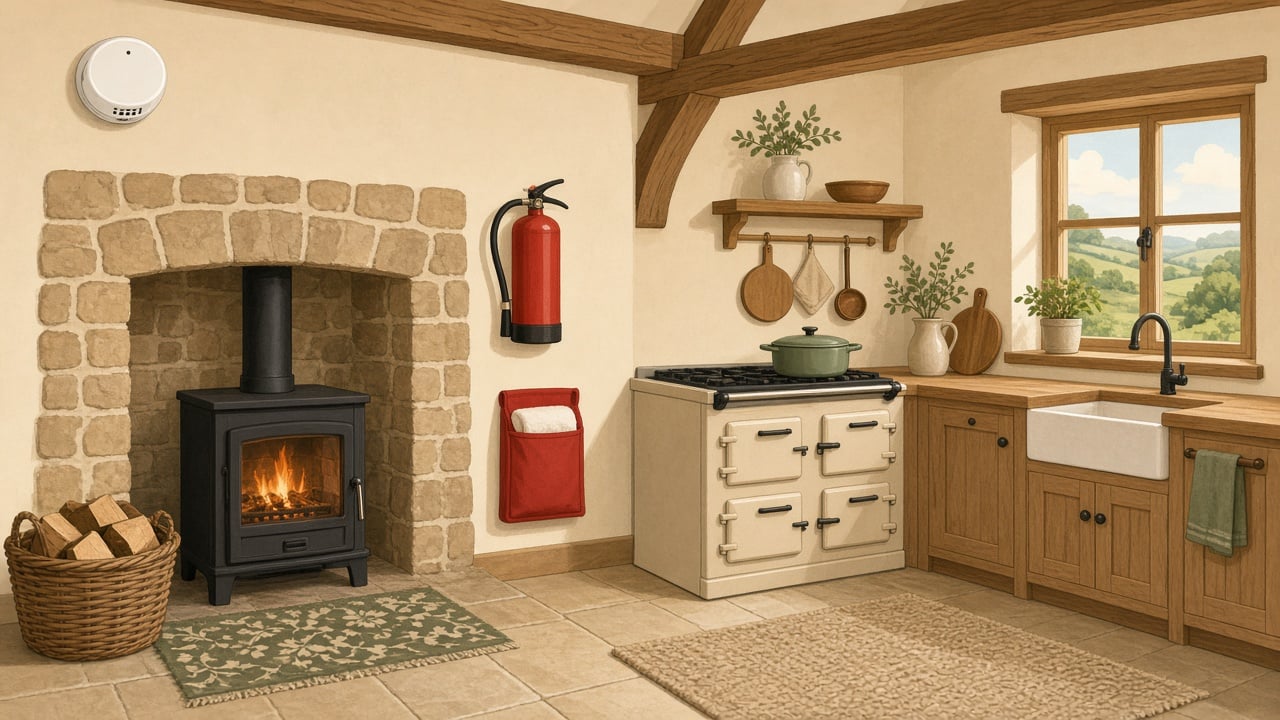
Emergency escape lighting usually isn't needed in a small cottage if there are torches in each bedroom or plug-in night lights on the stairs and hall. The guide's worked examples include a fire extinguisher and fire blanket in the kitchen. Explain escape routes and exits in your guest information pack.
How often should you review it?
The guide says an annual review is usually appropriate. You must also review it after any significant change, such as a renovation, a new wood burner, an extra bedroom, or after an incident like a fire. Keep a log of alarm tests and maintenance too; GOV.UK says this can be a paper log book or held electronically.
Can I do my own fire risk assessment?
Yes, if you feel able to interpret and apply the guidance to your property. If you don't, GOV.UK says you should use a competent fire risk assessor. Either way you stay legally responsible, and if someone else does it, you must record who they were.
England, Scotland and Wales are not the same
This guide covers England only. The small premises guide says separate guidance applies in Wales, and that it isn't intended for Scotland or Northern Ireland, where different fire safety legislation applies. In Scotland, also check your council's short-term let licence conditions.
How this fits with the England short-term let register
GOV.UK says England's mandatory national registration scheme for short-term lets "is expected to begin in March 2027", and its guidance still labels it "not yet in force." The government hasn't published what registration will ask for. Either way, a written fire risk assessment is a legal requirement today, so keeping it current is sensible preparation whatever the register ends up collecting.
Keep your fire risk assessment and certificates in one place
A fire risk assessment needs regular reviews, and it links to your EICR, gas safety record, alarm tests and other dates. RentReg is a free tool that keeps certificates, checks and expiry dates for each property in one place, so your fire risk assessment holiday let review date sits alongside your other renewals and doesn't slip. Use it if it helps; the law is the same either way.
Fire risk assessment holiday let FAQs
Is a fire risk assessment a legal requirement for an Airbnb in England?
If you charge guests to stay and the property isn't being occupied as a private dwelling, the Fire Safety Order applies and a fire risk assessment is required. GOV.UK says this applies "even if it is just for one night."
Does the fire risk assessment have to be written down?
Yes. Since 1 October 2023, Section 156 of the Building Safety Act 2022 requires all Responsible Persons to record the completed assessment in full.
How often should I review my fire risk assessment (holiday let or cottage)?
GOV.UK guidance says an annual review is usually appropriate, plus a review after any significant change or incident.
Do I need a professional fire risk assessor?
Not necessarily. You can do it yourself if you can apply the guidance confidently. If not, use a competent assessor. You remain responsible either way.
What smoke alarms does a holiday cottage need?
For small properties, the guidance expects interlinked mains-powered smoke and heat alarms with battery backup (Grade D1). Sealed long-life battery alarms (Grade F1) may be acceptable for around two to three years as a stopgap.
Who enforces fire safety in holiday lets?
Your local fire and rescue authority is normally the enforcing body.
Sources
- GOV.UK: Making your small paying guest accommodation safe from fire (updated 20 January 2025)
- GOV.UK: Check your fire safety responsibilities under Section 156 of the Building Safety Act 2022
- GOV.UK: Fire safety risk assessment: sleeping accommodation
- GOV.UK: Fire safety risk assessment: 5-step checklist
- GOV.UK: Letting out a self-catering holiday home in England: rules and regulations (updated 2 October 2026)
- legislation.gov.uk: Building Safety Act 2022, section 156
RentReg is not a law firm and this article is not legal advice. For your specific property, check with your local fire and rescue service or a competent fire risk assessor.